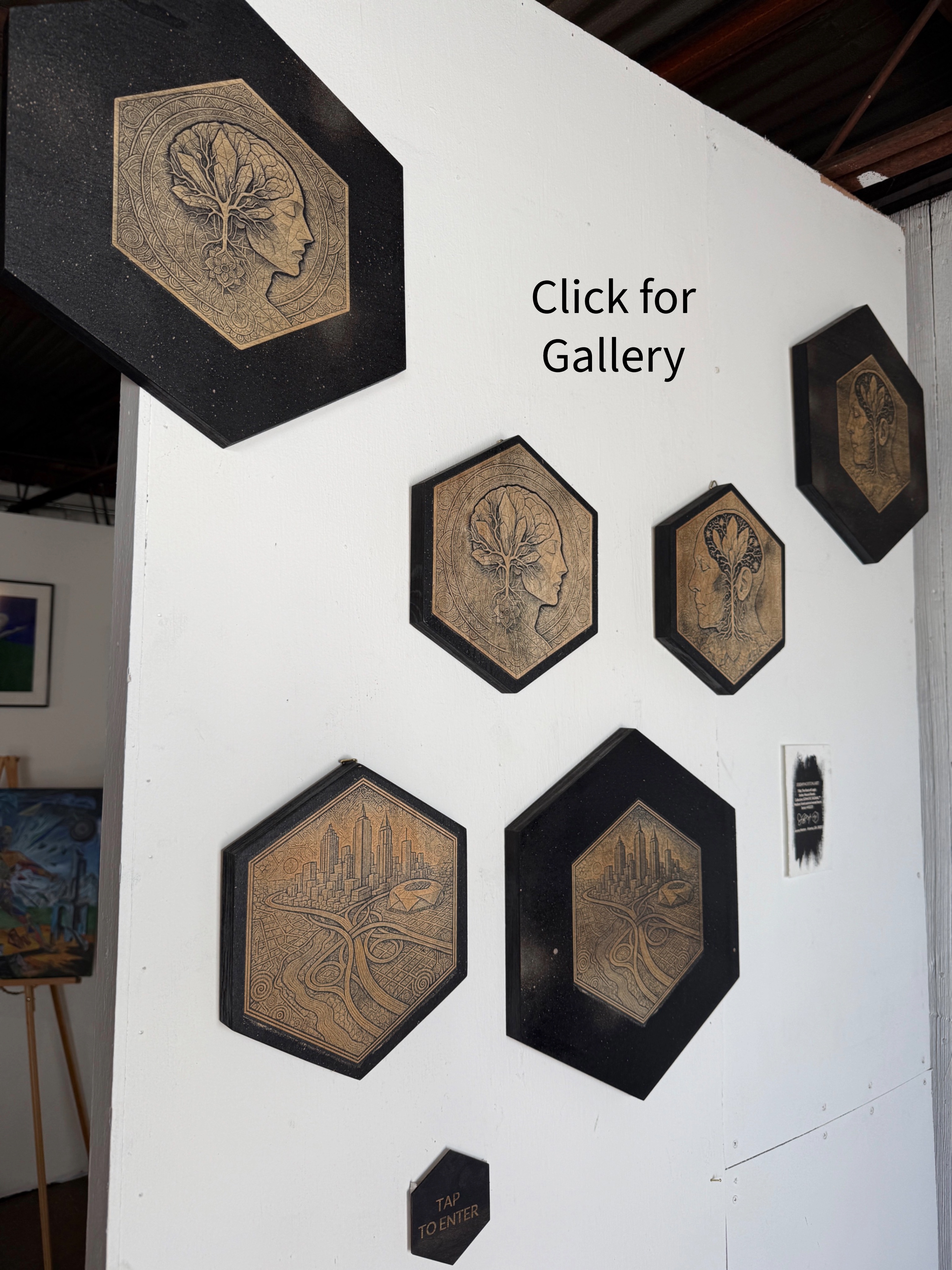
Taking Shape — Jeremy Morton
Slate + Wood Collection

Taking Shape

A material conversation between timber, stone, and sensory intelligence—where form emerges by signal. Closed eyes. Open witness. Cities as cortex. Stillness as resolution.

Collection Narrative

Neuroscience and nature share a grammar: branching, looping, converging, radiating. These works translate that grammar into wood and slate.

Closed Eyes / Open Witness
Vagus Roots & Auditory Spirals
Geode Logic & Fracture Memory
Signal Before Thought
City as Nervous System
Stillness as Resolution

Wood, Slate, Signal

These pieces begin with a physical truth: materials keep score. Wood records growth through resistance—grain becomes map. Slate holds compression—time collapsed into stone. Both respond honestly to force.

In this collection, neuroscience meets organic geometry: the vagus nerve branching like roots, auditory pathways spiraling like shells, the eye forming as a geode—layered, crystalline, inward.

Closed Eyes, Open Witness

Faces appear with eyes closed—not as absence, but as containment. The external gaze quiets so another mode of perception can activate: the witness that observes without disturbing.

In flow—studio or operating room—stillness brings clarity. Thought recedes. Precision increases. Signal becomes legible before language arrives.

Signal Measured in Milliseconds

In surgery, impulses move at measurable speeds—down to the millisecond. But outside clinical time, signals still guide us: breath, posture, tension, relief. The body resolves before the mind explains.

These works invite a quieter literacy: to feel the shift that comes before the sentence.

Zoom In / Zoom Out

Every piece holds two truths. Zoom in: burn depth, fracture lines, micro-geometry. Zoom out: form, rhythm, stillness, breath. When the current problem can’t be solved at its scale, you don’t push harder—you change resolution.

Stillness is not stopping. It is recalibration.

The City Takes on Its Own Nervous System

In the urban works, the city behaves like a living body. Buildings rise like cortical regions—specialized, dense, layered. Highways and transit systems carry signal like axons—routing load, urgency, connection. Intersections become synapses. Congestion becomes dysregulation. Flow becomes coherence.

Zoom out, and the city breathes. Zoom in, and it fires. Architecture—like the brain—adapts under pressure.

In Person

Taking Shape
Dunwoody Farmhouse (Cheek-Spruill House)
Jan 30 · 6:00–8:30 PM

Move slowly. Return twice to each work. Notice what changes in you. These are not objects that demand decoding—they’re instruments that reveal signal.

Collector Notes

Each piece is built with provenance in mind—editioning, hologram IDs, and certificate architecture that preserves the lineage of the work. Ask about slate + wood framing variants and Signal Slate™ expansions.

Taking Shape — Opening Night | Works in Textile, Wood, and Slate
Exhibition Opening
Taking Shape

Taking Shape

A duo exhibit where textile meets wood and slate — soft and hard, flexible and fixed — unified by structure, line, repetition, and the evidence of time and touch.

Fri Jan 30, 2026
6:00–8:30 PM
Dunwoody Farmhouse (Cheek-Spruill House)
Admission: Free. Come linger. Move between rooms. Let contrast sharpen your looking.

Curator’s Note

Curating doesn’t always begin with a theme or a date. Sometimes it begins with attention — the slow insistence of a work that lingers in the mind until the season is ready for it.

Denise Jackson first encountered Lauri Jones’s textiles and recognized a formal clarity that behaved like painting: geometry, repetition, structure, rhythm, restraint. Later, she met Jeremy Morton and felt the pairing click — not as a forced concept, but as an instinct for dialogue.

Why a Duo, Not a Solo

Duo exhibitions invite conversation. They keep the viewer moving — back and forth — discovering relationships rather than consuming objects. Pairing isn’t dilution; it’s a sharpening of perception.

Soft and hard. Textile and mineral. Flexible and fixed. Large-scale and intimate. The unity isn’t medium — it’s structure. Line. Repetition. Attention.

How It Lives in Space

This exhibit was conceived spatially: how someone enters a room, where the eye lands first, how it travels, where it pauses. In a historic house, pacing becomes palpable — rooms and hallways create contrast through proximity.

Lauri’s work breathes in its own room and into the hallway. Jeremy’s work holds its own room, creating a counterpoint you feel as you cross thresholds.

Somatic Signal™ Lens

Think of the show as a nervous system made visible: rhythm (stitch), pressure (burn), conduction (etched line), memory (repetition). The body reads pattern before it names it.

Texture becomes narrative. Material becomes mood. Time becomes collaborator — a signal you can stand inside.

The Artists

Two material languages, one shared devotion: pattern, repetition, the hand — and time as collaborator.

Lauri Jones

Textile • Stitch • Rhythm
  • Textiles approached through formal abstraction: geometry, repetition, structure, restraint.
  • Tradition reimagined with movement — stitching that creates pathways beyond the pattern.
  • Work that holds tension between control and release.

Jeremy Morton

Wood • Slate • Etch
  • Wood burn and etched works in wood and slate: slow, deliberate, precise.
  • Fixed, elemental materials — lines that carve pathways rather than sew them.
  • A disciplined process shaped by recovery and attention.

Opening Night

While it may be a frosty evening, you’re warmly invited to see how these conversations take shape in space.

Friday, January 30, 2026 • 6:00–8:30 PM
Dunwoody Farmhouse (Cheek-Spruill House)
5455 Chamblee Dunwoody Rd, Dunwoody, GA 30338

What to Expect

A room-to-room dialogue: soft/hard, flexible/fixed, layered/carved. Come ready to move slowly, return to a piece twice, and notice what changes in you between visits.

Exhibits aren’t just displays — they’re arguments made visually.

Complete the circuit. What moved you?

Thank you! Your submission has been received!
Oops! Something went wrong while submitting the form.